The future trend of self-checkout?! What you need to know about the way we'll pay tomorrow.

Self-checkouts are on the rise. Between 2019 and 2022, the number of stationary self-checkout terminals in German retail doubled, while mobile self-scanning alternatives increased tenfold! Customer acceptance and interaction with these new payment terminals have also shifted accordingly. The result is less skepticism, faster processes, and, consequently, higher customer satisfaction. However, many questions remain for potential operators. In this article, we will address the most important ones and answer them in detail so that no doubts remain.
How do self-checkout systems work?
First things first: How do self-checkout systems, or "SCOs," actually work?
At their core, most self-checkout systems are quite similar, though there are two main variants.
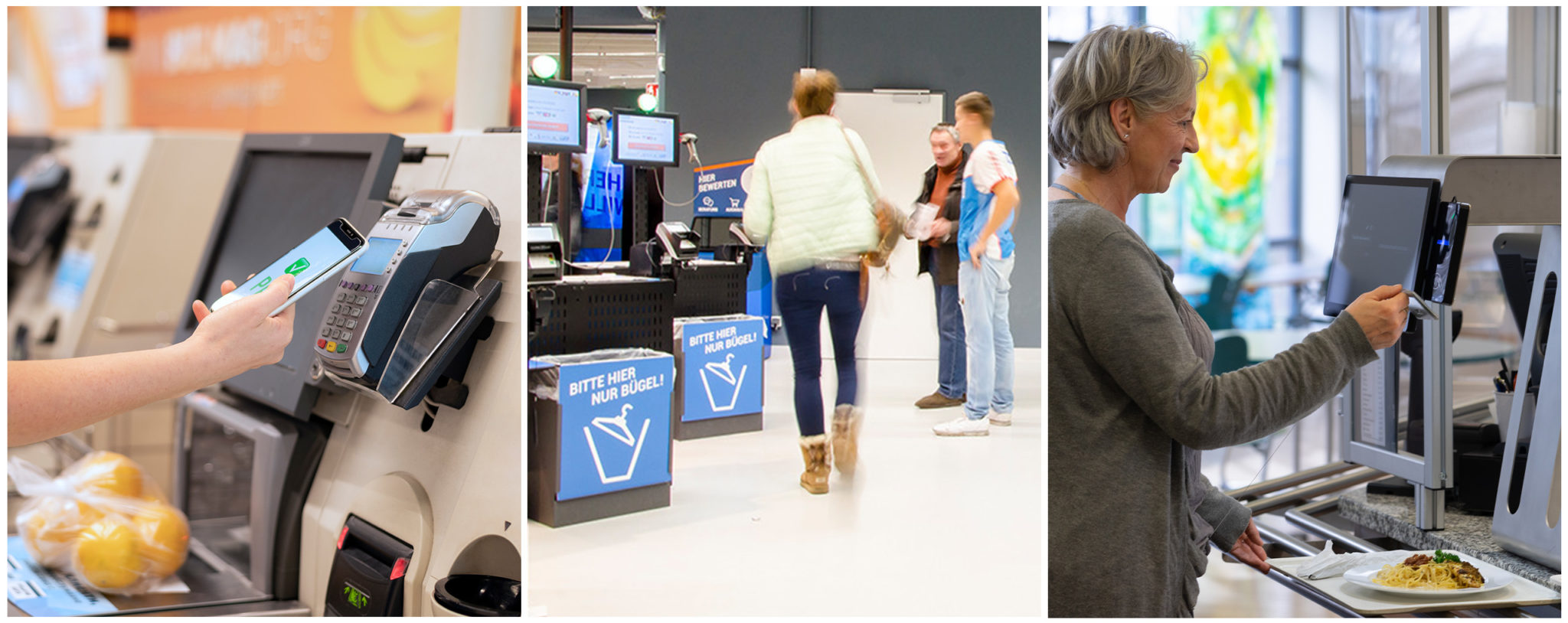
Stationary self-checkout terminals
In the first variant, the customer approaches a terminal where individual items are scanned either manually or automatically. These are known as "stationary self-checkout systems."
Mobile self-checkouts
In the second variant, the customer scans their items themselves before reaching the terminal, using either a smartphone or a handheld scanner. At the checkout, the customer simply transfers their full shopping basket and pays.
How do self-checkouts identify items?
Items can be identified in three different ways.
Via handheld scanner
The most common method, especially in supermarkets, is identification using handheld scanners that read the barcodes on the items. The advantage of this system in retail is that the necessary infrastructure is already in place, and the effort required for conversion is limited to the hardware. However, only items with a barcode can be scanned quickly; all others must be laboriously searched for in lists.
Using RFID tags
Another identification method is the self-checkout using RFID tags. These are attached to the items and then automatically read by the self-checkout terminal. This process significantly speeds up the checkout, as no item needs to be scanned by hand. However, implementing RFID tags is quite complex, as it must be ensured that all items are equipped with such tags.
Sports retailer Decathlon, for example, was able to implement this because its range consists almost exclusively of its own private labels. For supermarkets or kiosks, however, this is more difficult to achieve.
Through AI-based optical recognition
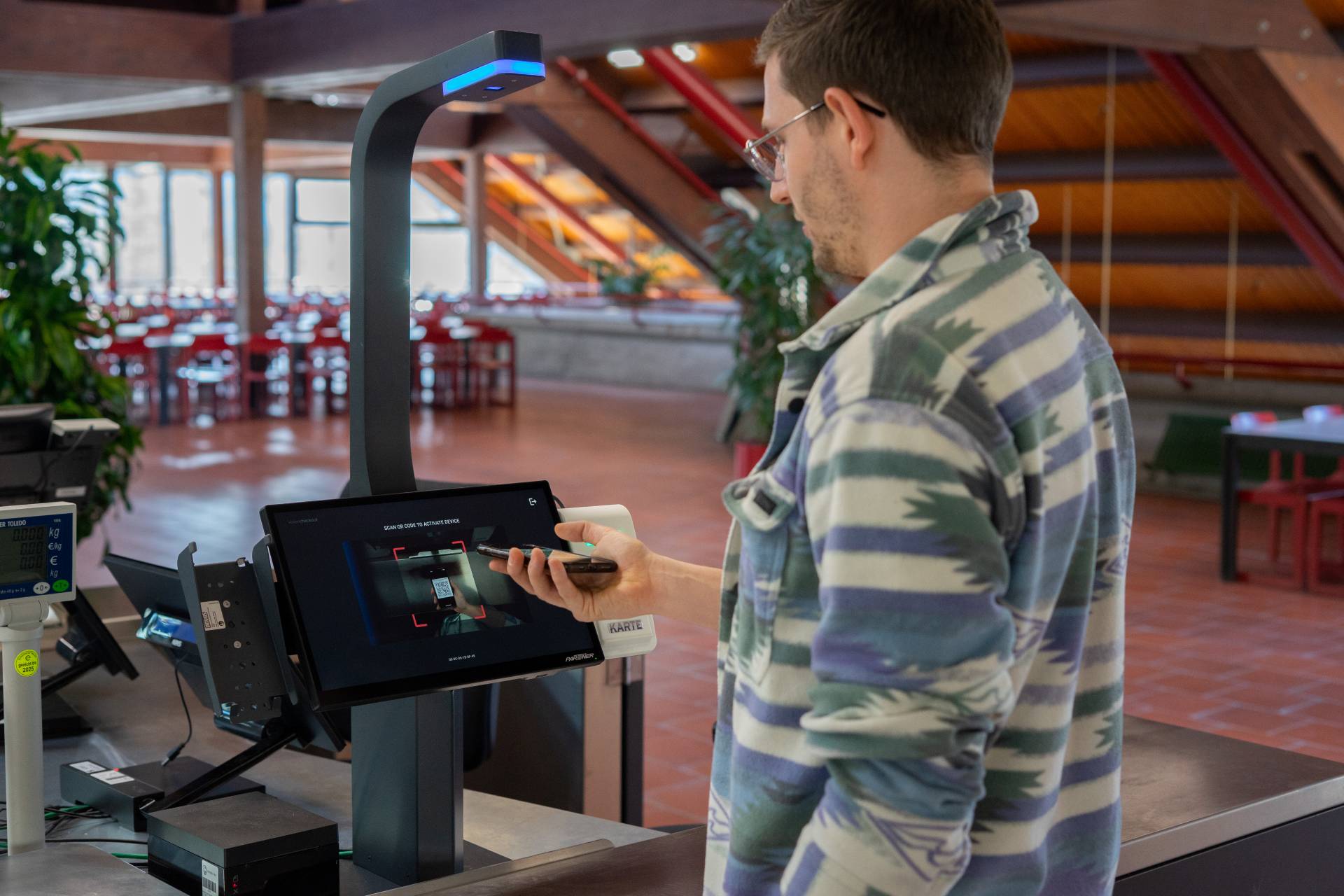
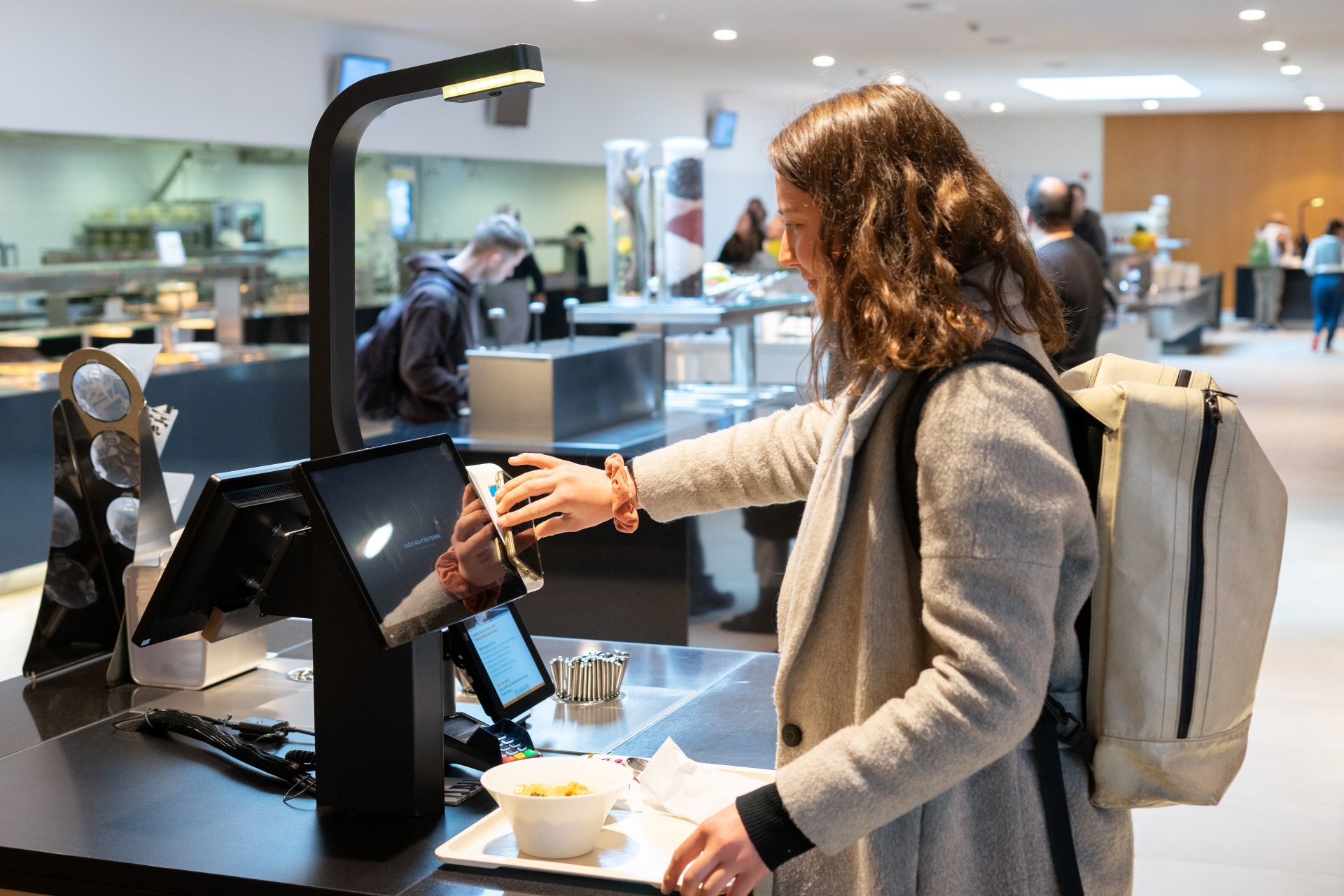
A third variant is the optical recognition of items using cameras. The customer places their items under a camera, and an intelligent algorithm identifies what is in the image. This system is just as fast as RFID tags, as the items are also recognized autonomously. This type of self-checkout is particularly well-suited for kiosks or catering businesses with freshly prepared dishes, as most of these items are served on plates that are neither labeled with RFID tags nor barcodes.
As you can see, there is unfortunately no "one size fits all" solution for self-checkouts. But why do companies take the time to choose a suitable self-checkout system?
Why do companies use self-checkouts?
The potential of self-checkout terminals is obvious.
1. Shorter wait times for customers, as multiple checkout stations can be accommodated and operated simultaneously, regardless of how much staff you have available.
2. More flexible staffing, as your entire team is no longer tied to the checkout during peak hours and can instead be deployed where more important work needs to be done.
3. The operator's image should also not be underestimated. In a competitive market, it is important not to be seen as outdated and to offer customers the most pleasant experience possible. Self-checkouts help with this.
What are the benefits of self-checkouts?
What does this mean for you in concrete terms? What advantages do self-checkouts offer your business? First, you gain more flexibility in staff scheduling. During peak times, you no longer need to schedule many trained cashiers; a few staff members are sufficient to perform spot checks or provide assistance.
At the same time, your customers can pay faster because more checkout stations are available. This naturally has a positive impact on customer satisfaction. Furthermore, high-traffic locations often see increased sales figures when queues are reduced through the use of self-checkouts.
Indirectly, the use of self-checkouts can also have a positive effect on your recruiting. An "innovative work environment" should be more than just a buzzword in a job posting. By implementing new technologies, you put your promises into action and offer your employees interesting, cutting-edge tasks.
What are the disadvantages of SCO?
Every silver lining has a cloud. That is true of everything. For one thing, you may have employees who are initially suspicious of new technologies. The key here is effective change management—bringing those very employees on board and shaping the digitalization process together. Many still hold the persistent belief that self-service checkouts take jobs away from people. To counter this, simple persuasion is not enough.
Show long-term plans that provide your employees with security and get them excited about new, varied ways of working. After all, there has never been a shortage of work in the hospitality industry. To combat the growing shortage of skilled workers, self-checkouts offer the opportunity to offload simple tasks to the SCO, allowing your staff to focus on service.
Another accusation against self-checkouts is that they practically invite theft. The EHI Retail Institute has published a study that proves the opposite. This study shows that in 85% of all observed stores, no increased inventory discrepancies were found. Self-checkouts are often installed in conjunction with additional security measures that prevent theft. You can find out what these measures are in the next question.
What measures prevent theft at self-checkout kiosks?
One of the most efficient measures against theft at the SCO is the use of service personnel. In this setup, one person is responsible for supervising 4-6 kiosks and performs random checks of purchased goods . While it certainly doesn't make sense to check every single receipt, the knowledge that they could be checked deters many customers from attempting to leave without paying for their items (in full).
To support this, traffic light systems can be attached to the self-checkouts themselves to indicate open payment processes and signal problems. This speeds up the process and makes the staff's work easier. Additionally, gates can be installed at the exits to perform random customer checks. However, care should be taken to ensure that these measures are proportionate and do not negate the benefits gained from the self-checkout.
Another option is to monitor checkouts centrally, which allows anomalies to be detected more quickly. Operators can then review individual shopping carts and respond more effectively. With image-based self-checkouts, there is an additional benefit: management can perform visual quality control using the photos taken of every dish.
What are the requirements for self-checkouts?
The requirements you need to meet to implement self-checkout in your facility depend on your specific circumstances and the type of self-checkout system you choose. Options range from extensive renovations to elegant tabletop versions. A decisive factor is the type of business you operate.
Supermarket
In supermarkets, converting to self-checkouts often involves major structural changes. Therefore, it is worth tackling the transition in conjunction with large-scale modernization projects.
Restaurants and corporate catering
In restaurants, especially corporate dining facilities, image-based self-checkouts are particularly common. These units are usually very easy to retrofit and only require a small amount of space along the tray slide, for example.
How much does a self-service checkout cost?
The costs for self-checkouts vary depending on the type of system used. To give you an idea of what to expect, here are a few examples of such models.
You purchase the SCO including the POS system and pay "only" for future updates
With this system, the initial acquisition costs are the most manageable. However, you run the risk of either spending unexpectedly large amounts of money on your self-checkout over time or ending up with outdated systems. Especially in a field as fast-growing as self-checkout, this can be your undoing. Consequently, this type of pricing is considered outdated and is now rarely practiced.
You upgrade your existing POS system to an SCO
If you are already satisfied with your existing POS system, there is no reason to switch. Most self-service checkouts can be retrofitted without much effort. It is important in this case to ensure compatibility between the SCO and the POS system and to maintain good communication with both partners regarding your project. The disadvantage of this solution is that you do not necessarily have a single point of contact. Furthermore, purchasing two different systems can end up being slightly more expensive than a complete package.
You rent the SCO together with the POS system, updates are included
In this case, you combine the advantages of the first two options. You rent both systems "as a service," and all updates and services are included in your subscription. Additionally, you can be 100% certain that the POS system and SCO will work well together, you have a central point of contact for all matters, and you always stay up to date.
Katrin Keppler
Seit über 5 Jahren im Bereich Self-Checkouts und Gastronomie unterwegs.